태양광·열·플라즈마 구동 화학 전환: 전기화학을 보완하는 광촉매·플라즈마 화학 경로로 에너지 전환과 환경 정화를 연구합니다.
Keywords
Photocatalysis · Plasma chemistry · Photoelectrochemistry
대표 논문
- 1
Synergy of Low-Energy {101} and High-Energy {001} TiO2 Crystal Facets for Enhanced Photocatalysis
Nitish Roy; Youngku Sohn; Debabrata Pradhan
ACS Nano 2013, 7, 2532-2540. DOI ↗ 📊 인용 ↗
📄 초록 (English) ▾
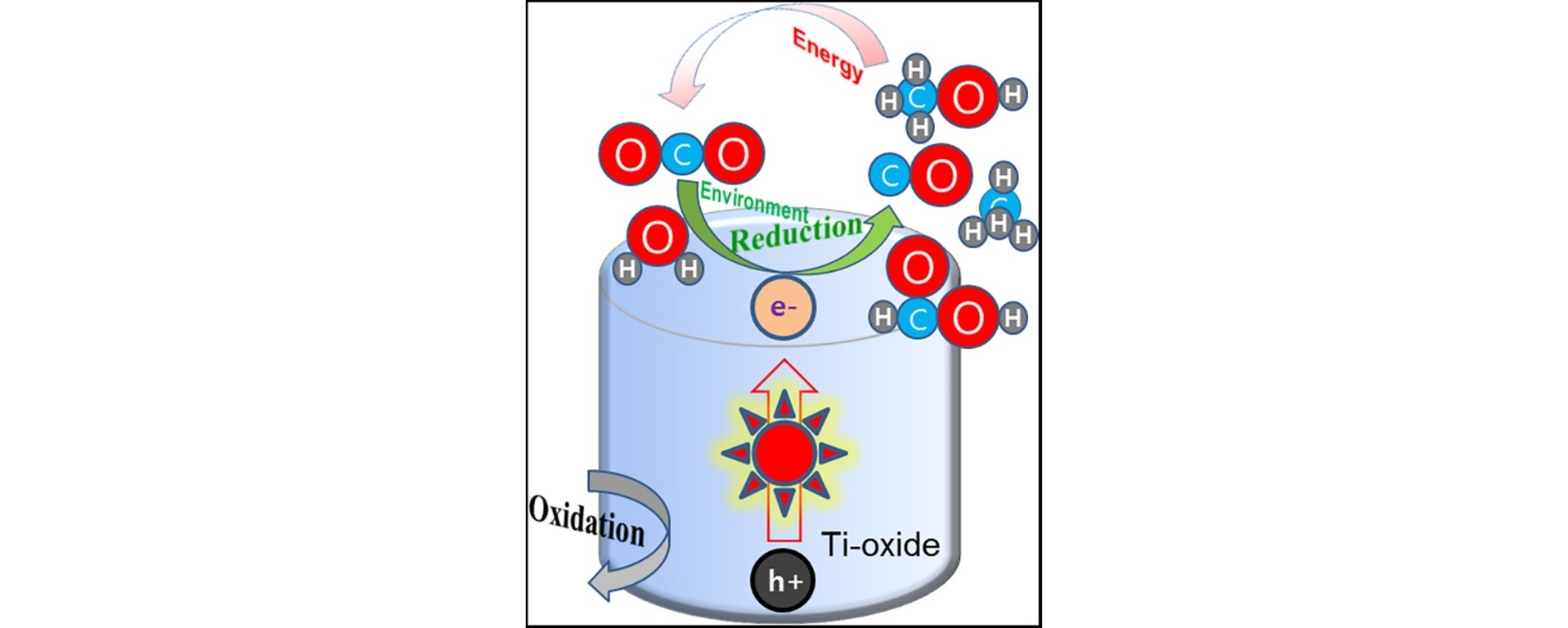
Controlled crystal growth determines the shape, size, and exposed facets of a crystal, which usually has different surface physicochemical properties. Herein we report the size and facet control synthesis of anatase TiO2 nanocrystals (NCs). The exposed facets are found to play a crucial role in the photocatalytic activity of TiO2 NCs. This is due to the known preferential flow of photogenerated carriers to the specific facets. Although, in recent years, the main focus has been on increasing the surface area of high-energy exposed facets such as {001} and {100} to improve the photocatalytic activity, here we demonstrate that the presence of both the high-energy {001} oxidative and low-energy {101} reductive facets in an optimum ratio is necessary to reduce the charge recombination and thereby enhance photocatalytic activity of TiO2 NCs.
- 3
Electrocatalytic syngas and photocatalytic long-chain hydrocarbon productions by CO2 reduction over ZnO and Zn-based electrodes
Ju Young Maeng; Ju Hyun Yang; Hye Ji Jang; Min Hee Joo; Young Jun Kim; Choong Kyun Rhee; Youngku Sohn
Appl. Surf. Sci. 2023, 609, 155349. DOI ↗ 📊 인용 ↗
📄 초록 ▾
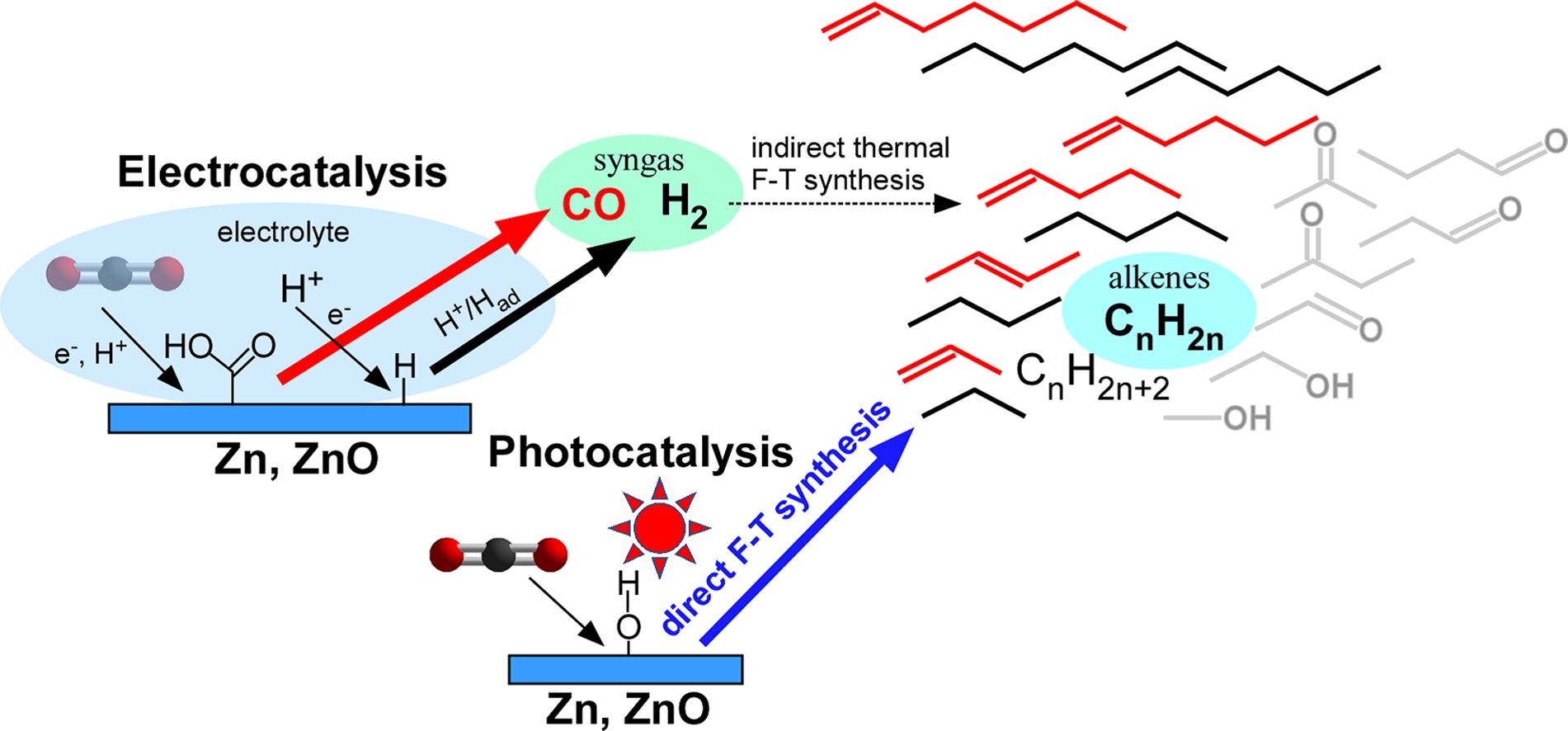
CO와 H2로 이루어진 합성가스를 직접 전기촉매적으로 생산하는 방법은 에너지 및 환경 문제 해결 전략으로 주목받고 있다. 본 연구에서는 Zn 및 산화 아연 나노막대(ZnO NR) 기반 촉매가 전기촉매적 CO2 환원을 통한 합성가스 생산에서 유망한 성능을 보임을 입증하였다. H2/CO 비는 표면 개질, 인가 전위, 전해질 및 Pt 증착으로 최적 조절할 수 있었다. ZnO NR은 CO2 환원 중 표면 재구성과 함께 금속 Zn으로 환원되는 것이 일반적으로 관찰되었다. 광촉매 CO2 환원에서도 CO, CH4, CH3OH 및 일부 유기 화합물이 확인되었다. 본 연구에서는 직접 광촉매 CO2 환원을 통해 상온에서 Fischer-Tropsch(F-T) 합성을 모사하여 CnH2n 및 CnH2n+2 형태의 장쇄 탄화수소(C7 화합물까지)를 생산할 수 있음을 보고한다. 기존 문헌의 결과와 달리 알케인보다 알켄이 우세하게 생성되었다. 이 독특한 결과는 에너지 및 환경 분야의 CO2 환원 전기촉매와 광촉매 개발에 유용한 정보를 제공한다.
※ 연구실에서 옮긴 비공식 번역입니다. 정확한 표현은 원문·DOI를 확인해 주세요.
원문 (English) ▾
Direct electrocatalytic syngas (CO and H2) production has been attracted as a strategy for energy and environmental solution. Herein, Zn and ZnO nanorod (ZnONR)-based catalysts were demonstrated to show promising performance in syngas production by electrocatalytic CO2 reduction. The H2/CO ratio was optimally tuned by surface modification, applied potentials, electrolytes, and Pt-deposition. ZnONR was observed to be commonly reduced to metallic Zn accompanying surface reconstruction during CO2 reduction. Photocatalytic CO2 reduction was also tested to observe CO, CH4, CH3OH, and some organic compounds. We report here a mimic of Fischer-Tropsch (F-T) synthesis can be achieved at ambient temperature by direct photocatalytic CO2 reduction to produce long chain hydrocarbons of CnH2n and CnH2n+2 (up to C7 compounds). Alkenes were observed to be predominant, compared with alkanes unlike the results reported in the literatures. The very unique results provide valuable information on the development of CO2 reduction electrocatalysts and photocatalysts for energy and environment.
- 4
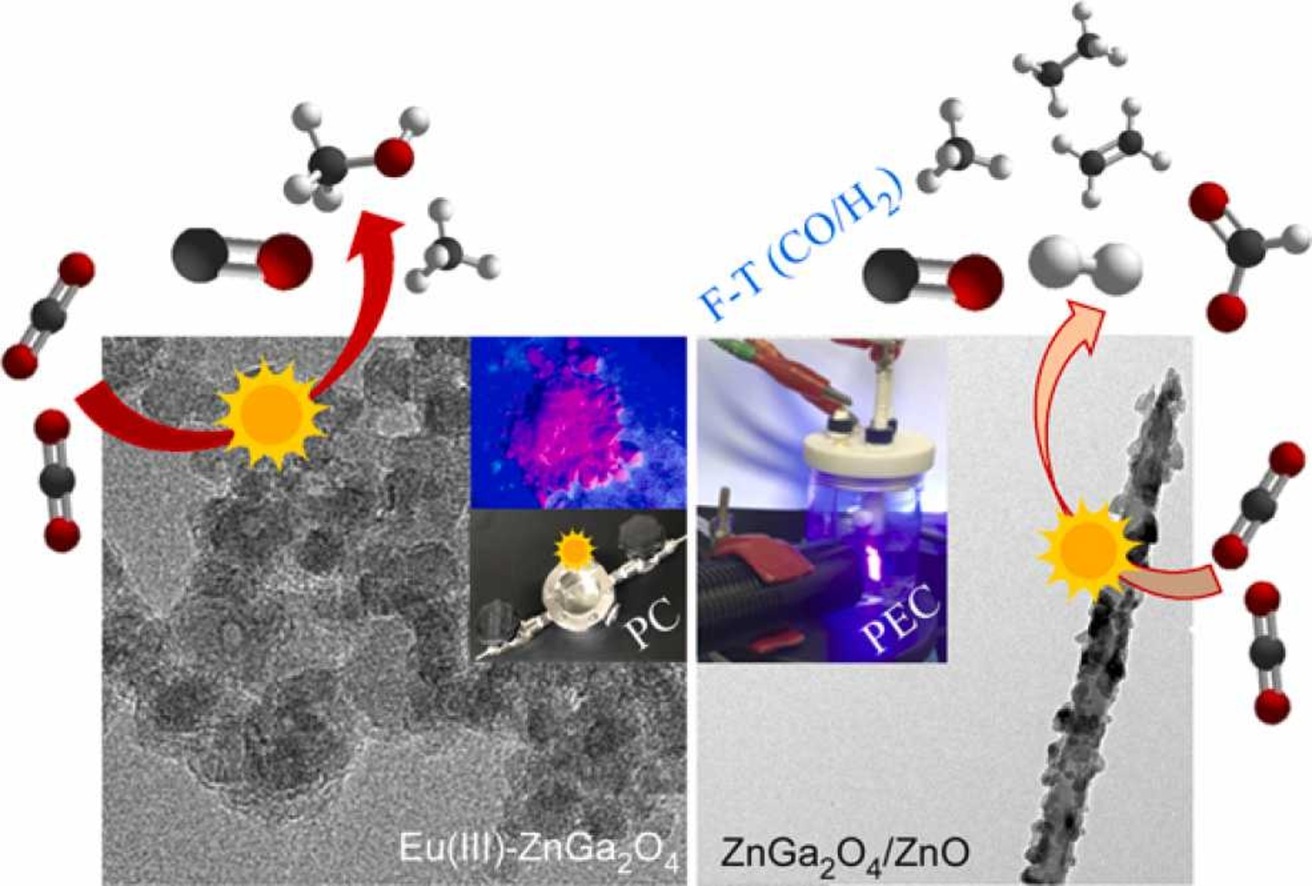
CO2 reduction by photocatalytic and photoelectrocatalytic approaches over Eu(III)-ZnGa2O4 nanoparticles and Eu(III)-ZnGa2O4/ZnO nanorods
Hye Ji Jang; Ju Hyun Yang; Ju Young Maeng; Min Hee Joo; Young Jun Kim; Sung-Min Hong; Choong Kyun Rhee; Youngku Sohn
J. CO2 Util. 2022, 60, 101994. DOI ↗ 📊 인용 ↗
📄 초록 ▾
개발된 여러 촉매를 이용하여 이산화탄소 환원으로 부가가치 생성물을 만드는 연구가 광범위하게 진행되어 왔다. 본 연구에서는 Eu(III)가 도핑된 ZnGa2O4(ZGO) 나노입자와 ZGO가 혼성화된 ZnO 나노막대(ZGO/ZnO NR)를 다양한 실험 조건에서 광촉매 및 광전기촉매 CO2 환원에 적용하였다. 광촉매 CO2 환원에서 CO/CH3OH 생산비는 ZGO의 경우 1보다 컸지만 ZGO/ZnO NR에서는 1보다 작았다. 전기화학적 CO2 환원에서는 CO와 H2가 주생성물이었고 폼산염이 소량 생성되었으며, 생성량은 Eu(III) 도핑을 포함한 변수에 따라 달라졌다. 인가 전위가 증가할수록 H2와 폼산염이 증가했고, CO는 -1.6 V 대 Ag/AgCl에서 가장 높은 패러데이 효율을 보였다. 합성가스 비(H2/CO)는 0.5-2.0 범위에서 효율적으로 조절할 수 있었다. 자외선은 H2에는 거의 영향을 주지 않으면서 CO 생성을 크게 증가시켰고 폼산염도 증가시켰다. 이 연구는 혼성 ZGO/ZnO NR, 도핑 및 자외선을 활용하여 환원 생성물과 합성가스 비를 제어하는 전략을 제시한다.
※ 연구실에서 옮긴 비공식 번역입니다. 정확한 표현은 원문·DOI를 확인해 주세요.
원문 (English) ▾
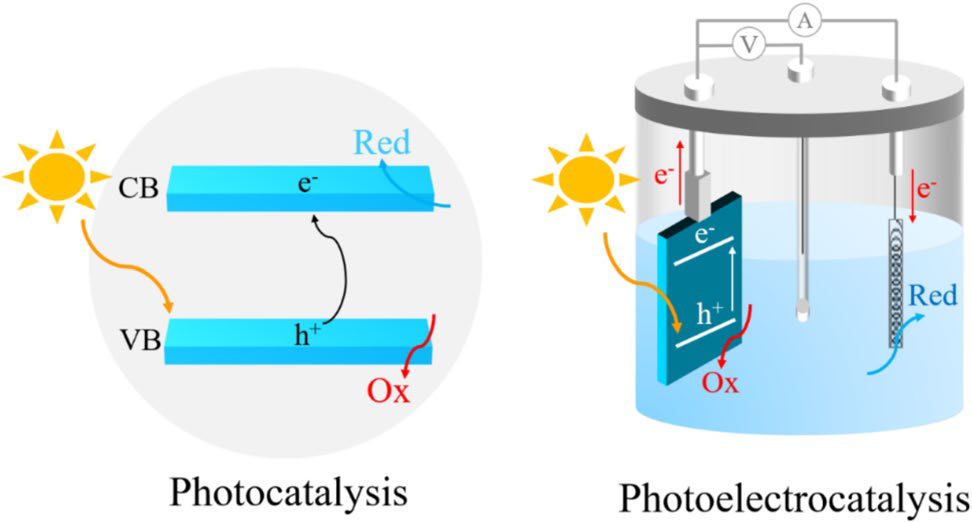
Value-added products by CO2 reduction have extensively been researched using many developed catalysts. Herein, Eu(III)-doped ZnGa2O4 (ZGO) nanoparticles and ZGO hybridized ZnO nanorods (ZGO/ZnONR) were evaluated for photocatalytic and photoelectrocatalytic CO2 reduction under diverse experimental conditions. For photocatalytic CO2 reduction, the CO/CH3OH production ratio was > 1 for ZGO, but < 1 for ZGO/ZnONR. For electrochemical CO2 reduction, CO and H2 were major products with minor formate, and dependent on the parameters including Eu(III)-doping. H2 and formate were increased with increasing applied potential, and CO showed the highest Faradaic efficiency at -1.6 V (vs. Ag/AgCl). Syngas (H2/CO) ratio was shown to be efficiently controlled from 0.5 to 2.0. UV light showed a dramatic effect on increasing CO production but not on H2. Formate was also increased under UV light. Overall, the present study provides strategies of controlling reduction products and syngas ratio by employing hybridized ZGO/ZnONR, doping, and UV light.
- 5
Insights into MXenes and MXene-based heterostructures for various photocatalytic applications
Shaikh Parwaiz; Youngku Sohn; Mohammad Mansoob Khan
Mater. Sci. Semicond. Process. 2025, 186, 109099. DOI ↗ 📊 인용 ↗
📄 초록 ▾
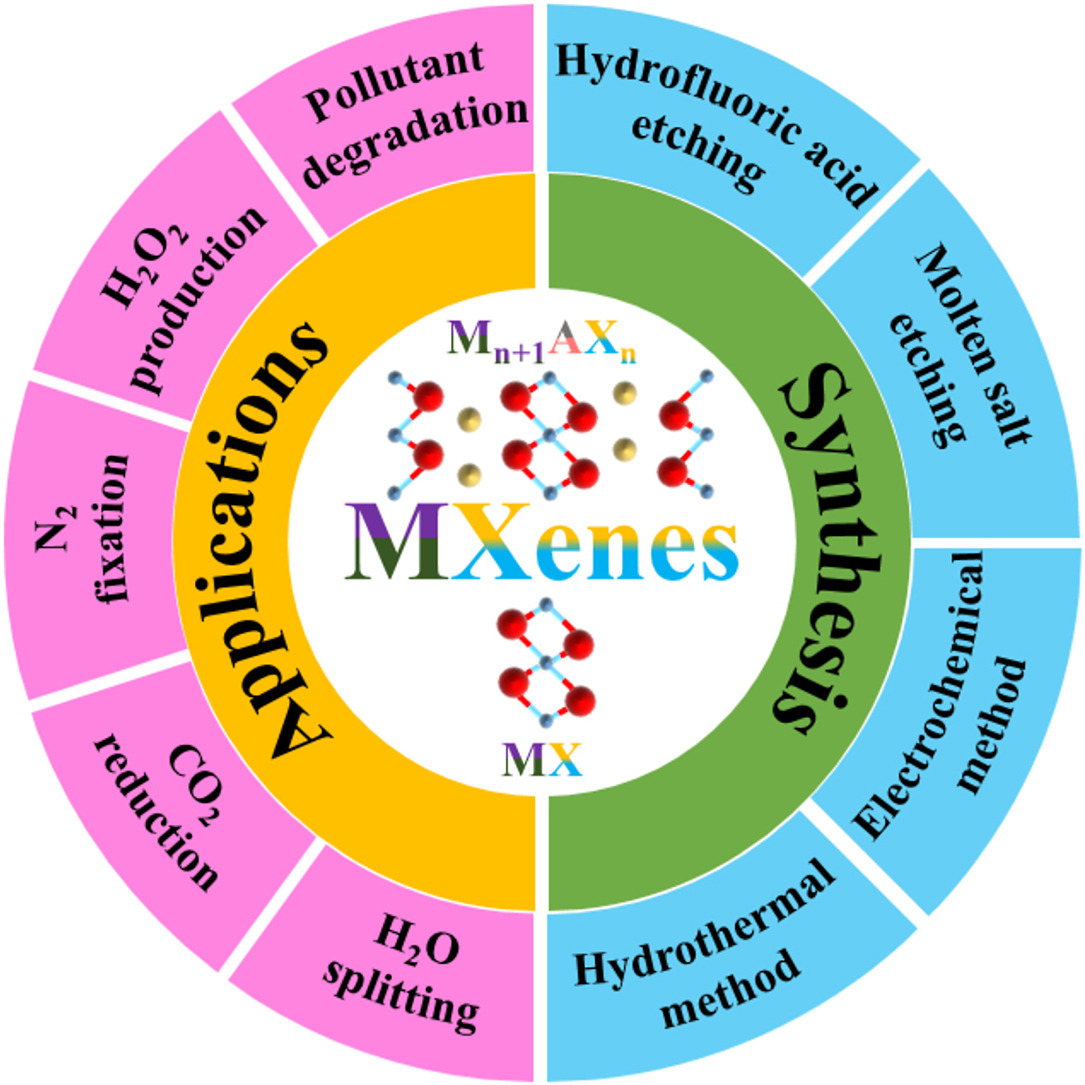
태양에너지를 화학에너지로 전환하는 광촉매 기술은 에너지 위기와 환경 문제를 해결할 수 있는 유망한 방법이다. 원자 수준으로 얇은 층상 구조에서 유래한 독특한 표면 특성과 물리화학적 성질을 지닌 맥신(MXene)은 다양한 광촉매 응용을 위한 유망한 후보로 부상하고 있다. 이 총설은 MAX 상과 맥신의 구조 및 분류를 간결하게 분석한다. 맥신 제조에 사용되는 전통적 HF 식각법, 무-HF 대안법, 첨가제 매개 합성 및 직접 합성 등 여러 합성 기술을 개괄한다. 또한 물 분해, CO2 환원, N2 고정, H2O2 생성 및 오염물질 분해를 위한 광촉매로서 맥신과 관련 이종구조를 조명한다. 후속 절에서는 더 나은 이해를 위해 상호보완적인 두 접근법인 실시간 특성 분석법과 제일원리 계산을 다룬다. 마지막으로 광촉매 분야에서 맥신 및 맥신 기반 이종구조의 잠재적 응용을 간략히 정리하고 향후 연구 방향을 제시한다. 이 총설은 독특하고 유망한 맥신 기반 광촉매를 설계하고 제작하는 데 유용한 참고 자료가 될 수 있다.
※ 연구실에서 옮긴 비공식 번역입니다. 정확한 표현은 원문·DOI를 확인해 주세요.
원문 (English) ▾
Photocatalytic conversion of solar energy into chemical energy is a prospective solution to the energy crisis and environmental challenges. MXenes, characterized by their unique surface features and physicochemical properties derived from their atomically thin layered structures, are becoming promising candidates for various photocatalytic applications. This review offers a concise analysis of the structure and categorization of MAX phases and MXenes. The discussion covers a succinct overview of different synthesis techniques employed in the preparation of MXenes, encompassing traditional HF etching methods, HF-free alternatives, additive-mediated synthesis, and direct synthesis. This study highlights MXenes and related heterostructures as photocatalysts for H2O splitting, CO2 reduction, N2 fixation, H2O2 generation, and pollutant degradation. We incorporated two complementary approaches, in-situ characterization methods, and first-principles calculations, in the following section to provide a better understanding. We conclude this review by offering insights into future directions and a concise summary of the potential applications of MXenes and MXene-based heterostructures in photocatalysis. This review could serve as a valuable reference for the design and fabrication of unique and promising MXene-based photocatalysts.
- 6
Nonequilibrium Photothermal Reactions Under Pulsed Laser Excitation: Mechanisms, Dynamics, and Applications
Huieun Shim; Sy Khiem Nguyen; Hyeonji Lee; Jaehee Shin; Ilsun Yoon; Youngku Sohn
ChemCatChem 2026, 18, e01870. DOI ↗ 📊 인용 ↗
📄 초록 ▾
펄스 레이저 여기는 에너지를 표면에 매우 국소적이면서도 시간이 제어된 방식으로 전달함으로써, 촉매반응에서 비평형 조건에 접근하는 유력한 방법이다. 연속파 조사와 달리 펄스 레이저는 펨토초에서 나노초에 이르는 극히 짧은 순간에 에너지를 집중시켜 급격한 온도 구배와 국부 가열, 나아가 전자계와 격자계의 부분적 비결합까지 유발할 수 있다. 이러한 효과는 표면 재구성, 중간체 결합 세기의 변화, 평상시에는 접근할 수 없던 반응 경로의 활성화로 이어지는 경우가 많다. 이와 같은 과도적 광열 환경은 열과 전하의 국재화가 생성물 선택성을 크게 좌우하는 CO2 환원, 수소 발생, 암모니아 합성 등에서 상당한 가능성을 보여 왔다. 본 총설은 성장하고 있는 펄스 광열 촉매 분야를 조망하여 레이저–물질 상호작용의 기본 메커니즘, 열적 영역과 비열적 영역의 구분, 그리고 주요 레이저 변수가 표면 반응성에 미치는 영향을 정리한다. 아울러 대표적인 반응계들을 살펴보고, 시간분해 분광법과 전산 모델링의 최근 발전이 그 기저의 동역학을 규명하고 차세대 촉매 플랫폼의 합리적 설계에 어떻게 기여하는지 논의한다.
※ 연구실에서 옮긴 비공식 번역입니다. 정확한 표현은 원문·DOI를 확인해 주세요.
원문 (English) ▾
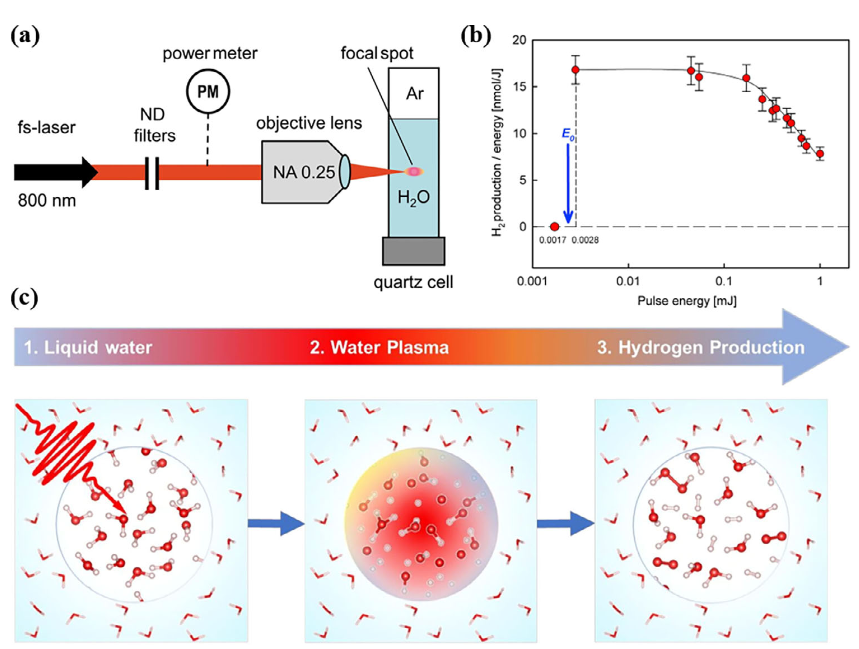
Pulsed laser excitation offers a compelling approach for accessing nonequilibrium conditions in catalysis by delivering energy to surfaces in a highly localized and time‐controlled manner. In contrast to continuous‐wave irradiation, pulsed lasers concentrate energy into extremely short bursts—ranging from femtoseconds to nanoseconds—which can induce steep thermal gradients, localized heating, and even partial decoupling between electronic and lattice subsystems. These effects often lead to surface restructuring, altered binding of intermediates, or activation of otherwise inaccessible pathways. Such transient photothermal environments have shown considerable promise in driving reactions like CO 2 reduction, hydrogen evolution, and ammonia synthesis, where heat and charge localization strongly influence product selectivity. This review examines the growing field of pulsed photothermal catalysis, highlighting the fundamental mechanisms of laser–matter interactions, the distinction between thermal and nonthermal regimes, and how key laser parameters affect surface reactivity. We also survey selected reaction systems and discuss how recent developments in time‐resolved spectroscopy and computational modeling are helping to unravel the underlying dynamics and inform the rational design of next‐generation catalytic platforms.