혁신적 전기화학 경로로 NOx·아질산염·질산염을 고부가가치 암모니아(NH3)로 전환합니다 — 오염물질을 연료·비료 원료로.
Keywords
NO3RR · NH3 · Nitrogen cycle
대표 논문
- 1
Electrochemical reduction of nitrate to ammonia using Fe-based catalyst: Insights into N2, CO2, and CO environments
Seon Young Hwang; Gaeun Yun; So Young Kim; Choong Kyun Rhee; Youngku Sohn
J. Environ. Chem. Eng. 2024, 12, 114482. DOI ↗ 📊 인용 ↗
📄 초록 (English) ▾
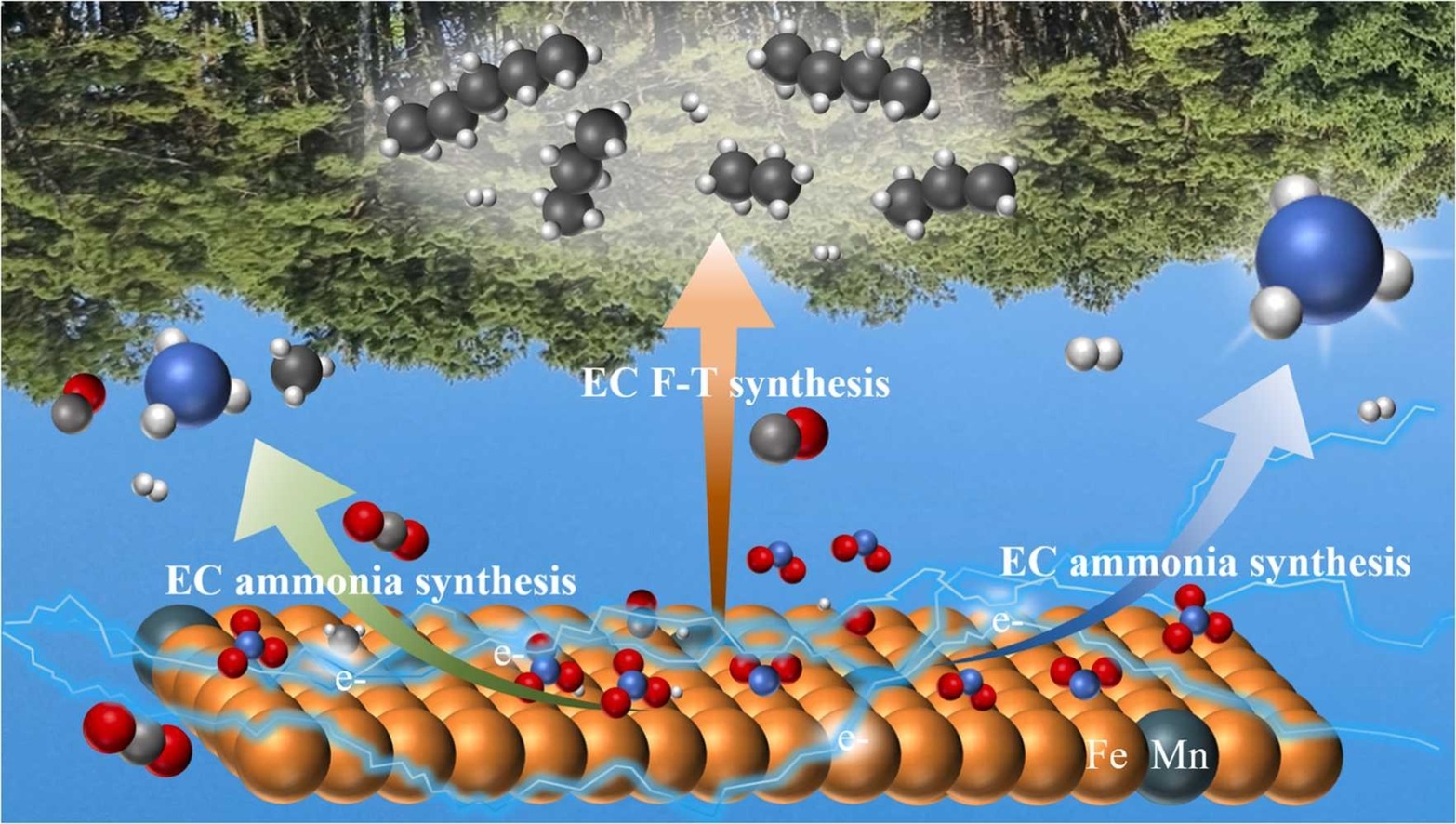
Electrochemical (EC) reduction of nitrate/nitrite for ammonia production is a key area of research in the realm of nitrogen pollutant treatment and recycling efforts. In this study, we utilized a commercial Fe(Mn) alloy to investigate EC reductions of nitrate/nitrite ions under N 2 , CO, and CO 2 -saturated conditions, shedding light on the influences of different feeding gases. Under N 2 conditions, the ammonia production Faradaic efficiency (FE) reached 60 %; however, it significantly decreased under CO 2 conditions. The presence of CO as a feeding gas proved detrimental, resulting in no ammonia production. Surprisingly, the Fe(Mn) alloy demonstrated superior EC Fischer-Tropsch (F-T) synthesis chemistry under CO conditions, generating CH 4 and long-chain hydrocarbons (C n H 2n+2 and C n H 2n , where n=2–7). This contrasts with existing literature, where such alloys typically perform better under CO 2 conditions. Notably, alkanes were found to be more predominant than their corresponding alkenes . The Anderson-Schulz-Flory equation plots exhibited significant linearity, resembling the traditional Fischer-Tropsch chain growth mechanism. This original discovery introduces new possibilities for employing commercial-grade Fe alloy in the direct EC F-T synthesis using CO, facilitating the production of long-chain hydrocarbons. Moreover, it paves the way for nitrate/nitrite ion treatments in analogous processes within diverse gas environments.